
It’s 7:40 on a weekday morning and you’re digging through the bathroom drawer for your good concealer. You find three lip liners, a mascara you don’t remember buying, a blush with a cracked lid and, eventually, the concealer, which has rolled to the very back. Sound familiar? Makeup storage sounds like a decorating project, but it does two practical jobs. It keeps your products away from heat, light and air so they last as long as they should, and it lets you see what you own so you use it before it goes bad.
The right setup depends on how much makeup you have, not how much you want to spend. A small daily kit needs very little. A bigger collection needs a way to see everything at a glance. And a full vanity station is wonderful for a few people and too much for most. This guide is part of our makeup hygiene guide, so we’ll cover the shelf-life side as well as the organizing side.
What heat, light and air do to makeup
Heat softens waxes and breaks emulsions, which is why a foundation left in a warm spot can separate into oil and pigment. Light fades colors and wears down the preservatives that keep products safe. Air dries out creams and lets oils oxidize, which is why you sometimes find a crusty ring around the neck of a tube. A cool, dark, closed spot slows all three, and a tightly closed cap does more for shelf life than any organizer you can buy.
The best spot in most homes is a bedroom drawer or a closet shelf. The worst spots are a sunny windowsill, your car, or an open tray next to a radiator. The bathroom sits somewhere in between. A daily shower puts the room through a swing of heat and steam, and moisture is what lets mold take hold in pressed powder. If the bathroom is your only option, use a closed cabinet instead of an open shelf and keep everything capped. Our guide to where to store your makeup goes room by room.
A small kit that fits in one drawer
If your everyday routine is a base, a blush, a mascara and a couple of lip products, you don’t need much. You need walls. Things that stand upright are things you can see, and a loose pile in a drawer is where a lip liner hides for two years past its prime.
A divided tray for your daily drawer
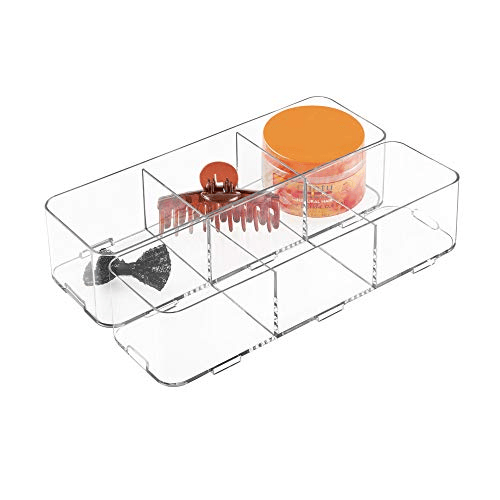
The iDesign Clarity Cosmetic Drawer Organizer is a shallow divided tray that drops into a standard drawer. It has deeper sections for tubes and mascaras, shallow ones for compacts and pencils, and a non-slip base so it stays put when you open the drawer. It usually runs about $12 to $22. In a tray like this, putting something away is the same motion as finding it again, and the closed drawer already keeps everything dark and cool. For a small collection, it’s a finished answer, not a placeholder.
Stackable bins for odd-sized drawers
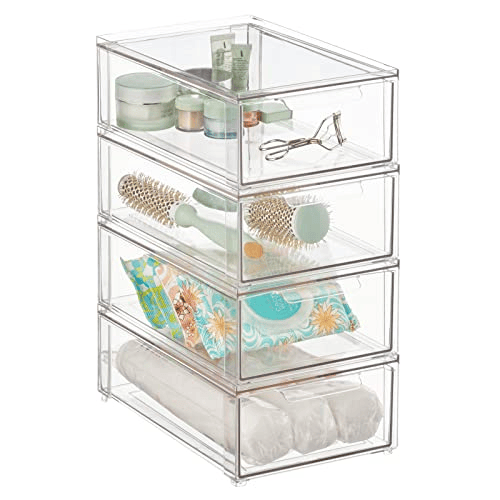
If your drawers are an awkward size, mDesign stackable bins do the same job in smaller pieces. You can line them up, mix sizes, or stack them in a deep drawer so you’re using the height without burying anything.
A pouch for what rides in your bag
A zip pouch still earns its place for the few things you carry every day, like a lip balm, a compact and a mini mascara. Keep it small so it stays a touch-up kit instead of a second junk drawer, and wash it often. The case for that is in the makeup bag nobody washes.
A single tray stops working once you own three foundations and a palette habit, because that’s when stacking starts, and stacking is how things get forgotten.
A bigger collection you can see at a glance
The sign you’ve outgrown a drawer isn’t the amount of makeup. It’s that you bought a second concealer because you couldn’t find the first one. That’s a visibility problem, and clear, modular storage fixes it.
Clear drawers that grow with you

The Sorbus Acrylic Makeup Organizer is a set of interlocking drawers and open compartments you can stack and rearrange, usually for about $35 to $60. You can give winter bases a deep drawer and the summer palette a shallow one, then swap them in a minute when the season changes. The clear sides let you read everything you own at a glance, so the blush you bought in spring gets used that spring instead of turning up a year later smelling faintly of crayon.
One thing to know about clear acrylic is that it lets light right through. On a bright windowsill, it’s close to the worst place you could keep makeup, since UV fades pigment and wears down preservatives. Set it in a closet or on a shelf away from the window. You only need to see inside when the door is open.
A liner that catches the mess
A roll of non-slip drawer liner cut to fit your trays keeps things from sliding, catches loose powder, and lifts out for a quick rinse. It’s a small buy that makes cleaning much easier.
A full vanity station, and who it’s for
A lighted vanity looks like the finish line, and for some people it’s exactly right. For a ten-minute makeup routine, though, it’s usually more than you need.
A lit desk with plenty of drawers
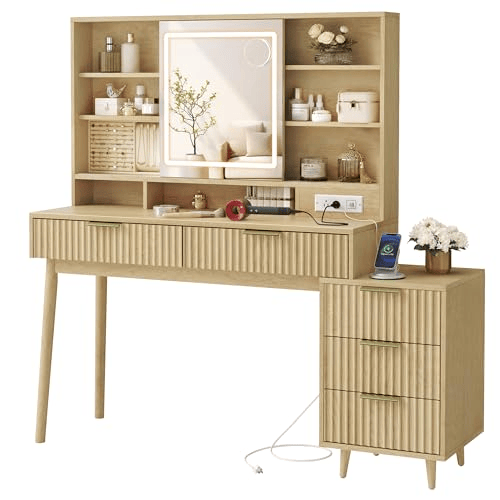
The SONGMICS Vanity Desk with Lighted Mirror is a pretty piece of furniture, with dimmable LED bulbs, a run of drawers and even, shadow-free light that makes blending along your jawline much easier than under a bathroom ceiling light. It usually costs about $150 to $260.
It’s a great buy for renters and dorm dwellers with no usable bathroom counter, where the vanity becomes the only surface. It’s also ideal for anyone who does makeup on other people and needs steady light, and for anyone whose eyesight makes an overhead fixture hard to work with, since a lit mirror at eye level helps a lot.
For everyone else, a few things are worth weighing. All those drawers can hold more makeup than one face can finish before it goes off, and it’s easy to let extra space turn into permission to keep everything. It takes up permanent floor space. And anything left uncapped on that open surface sits in light and air every day, so close things up when you’re done.
A mini fridge for a few skincare products
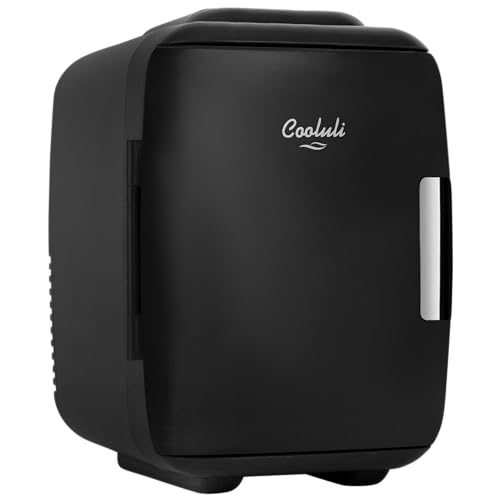
A beauty fridge is fun, and it’s handy for a short list of skincare items. Vitamin C serums can break down faster when warm, some retinol and peptide formulas like it cool, and a chilled eye gel or sheet mask feels great on a summer morning. For makeup, it doesn’t do much. Powders, lipsticks and mascara get nothing from the cold, and moving creams in and out of a fridge can thicken them or make them separate. It makes the most sense as a skincare treat, not makeup storage.
What storage can’t fix
Good storage helps a product reach the shelf life it was made for, but it can’t stop the clock. That little open-jar symbol on the back of the package, the one that reads 6M or 12M, starts counting the day you open the product, not the day you put it away. A spotless drawer won’t stretch it, and neither will a fridge.
Storage can’t undo germs either. Once fingers have been in a jar or a wand has gone back into a tube after touching your lash line, bacteria can get in. Mascara is the strict one. The FDA and most eye doctors suggest replacing it about every three months, since a wet, dark tube is a friendly place for germs. Toss any eye product right away after an eye infection, and see a doctor if your eyes get red, swollen or painful after using makeup.
Setting it up so it stays neat
Start by emptying everything onto a towel, because you can’t organize what you haven’t seen. Check each product’s open-jar symbol and give it a sniff. Anything that smells sharp, waxy or sour goes, along with any foundation that’s separated and any mascara that’s gone clumpy or stringy.
Sort what’s left by how often you use it, not by type. Your daily five, like base, brows, mascara, blush and your go-to lip, go in front at hand level, with weekly items behind them. Special-occasion pieces and anything still sealed can live in a closed box on a closet shelf.
Then a few habits keep it that way. Cap everything before it goes back, and store tubes upright so product stays at the end you use. Wipe the trays every month or two with a barely damp cloth and a little dish soap, since powder fallout mixes with skin oil and leaves a film, and let them dry fully before refilling. Try one in, one out, so your collection stays a size you can finish. If counter space is tight, go vertical and closed, with a stackable set on a closet shelf, a hanging organizer on the back of a door, or a slim cart beside the dresser. You’ll find more ideas in our Makeup archive.


