
Ketoconazole shampoo is a really good dandruff fighter, and that’s honestly the best reason to buy it, even with all the chatter online about Nizoral and thinning hair. It’s an antifungal, and the drugstore version is 1% with one listed use, dandruff. Neither that label nor the 2% prescription one mentions hair growth. A handful of small studies did find thicker hairs with 2%, which is where the buzz comes from, but the bigger trials that would settle it haven’t happened yet. If your scalp is flaky or itchy and you’re shedding too, it’s a cheap, sensible thing to add. Just don’t lean on it alone to fill in a widening part.
Drugstore 1% next to prescription 2%
| Detail | Nizoral 1% (over the counter) | Ketoconazole 2% (prescription) |
| Labeled use | Flaking, scaling and itching from dandruff | Tinea (pityriasis) versicolor, a yeast rash on the trunk |
| Who can use it | Adults and children 12 and over; under 12, ask a doctor | Safety and effectiveness in children not established |
| How often, per label | Every 3 to 4 days for up to 8 weeks, then as needed | As your prescriber directs |
| Hair loss on the label? | No | Only as a rare reported side effect |
| Pregnancy | Ask a doctor before use if pregnant or breastfeeding | Use only if the benefit justifies the risk; not detected in blood after long-term shampooing |
The yeast it keeps in check
On your scalp, ketoconazole’s job is to keep a yeast under control. That yeast lives on everyone’s skin, snacks on oil, and is behind a lot of everyday dandruff. It also drives seborrheic dermatitis, the redder, greasier and more stubborn cousin of dandruff. If you’d like the fuller story, our guide to dandruff causes and fixes digs into the yeast side.
The American Academy of Dermatology (AAD) names ketoconazole as one of the ingredients to look for in a dandruff shampoo, alongside zinc pyrithione, selenium sulfide, salicylic acid, sulfur and coal tar. Every one of those is there to calm flakes and itch, not to grow hair.
How a dandruff shampoo got linked to thinning
The idea grew out of a reasonable hunch. If scalp yeast and redness are part of the picture for some people, calming them might be good for hair, too.
The study people quote most came out of Belgium and compared 2% ketoconazole shampoo with a plain shampoo, with or without 2% minoxidil, in people with hereditary hair loss. Ketoconazole improved hair density, hair thickness and the share of actively growing hairs nearly as much as minoxidil did, and scalps got less oily along the way. Even so, the researchers said a larger, carefully controlled study was needed before anyone could say what it meant. A later study from Japan found 2% ketoconazole helped clipped hair grow back faster than a plain solution, but that one was done in mice.
Where the evidence stands today
It’s promising but still thin. When researchers gathered up everything published, there were only a few small human studies and a couple in animals. The human ones found thicker hairs, and some showed visible improvement in photos and in how people felt about their own hair. The reviewers called ketoconazole a hopeful add-on or alternative and asked for proper trials.
A few things that research can’t tell you yet:
- Whether it helps your kind of shedding. The studies looked at hereditary thinning, not hair loss from stress, a new baby or a thyroid problem.
- Whether the drugstore strength works. The key studies used 2%, the prescription strength, and Nizoral is 1%.
- How much difference it would make for you, since small studies can’t give a reliable number.
A Canadian expert panel on hereditary hair loss put ketoconazole shampoo in its second tier, behind minoxidil and the prescription options. When the AAD lists at-home hair loss treatments with real studies behind them, it names minoxidil, laser devices and microneedling, and ketoconazole isn’t on that list.
There’s one twist on the prescription label. In trials of 2% ketoconazole shampoo for dandruff, fewer than 1% of people noticed more hair loss than usual, and hair loss, along with changes in hair texture and color, has also come up in reports after the drug was approved. It’s rare, but it’s good to know.
Working it into your wash days
Nizoral’s directions are simple. Wet your hair, lather well, rinse, and repeat every 3 to 4 days for up to 8 weeks, then use it only as needed for dandruff. On the other days, your usual shampoo and conditioner are fine.
The AAD has a few tips that apply to any dandruff shampoo. Some need to sit on your scalp for 5 to 10 minutes before rinsing. If your hair is fine, straight or oily, you might wash daily and use the medicated one twice a week. If it’s curly or coily, about once a week may suit you better, kept on the scalp only, since it can dry out your lengths.
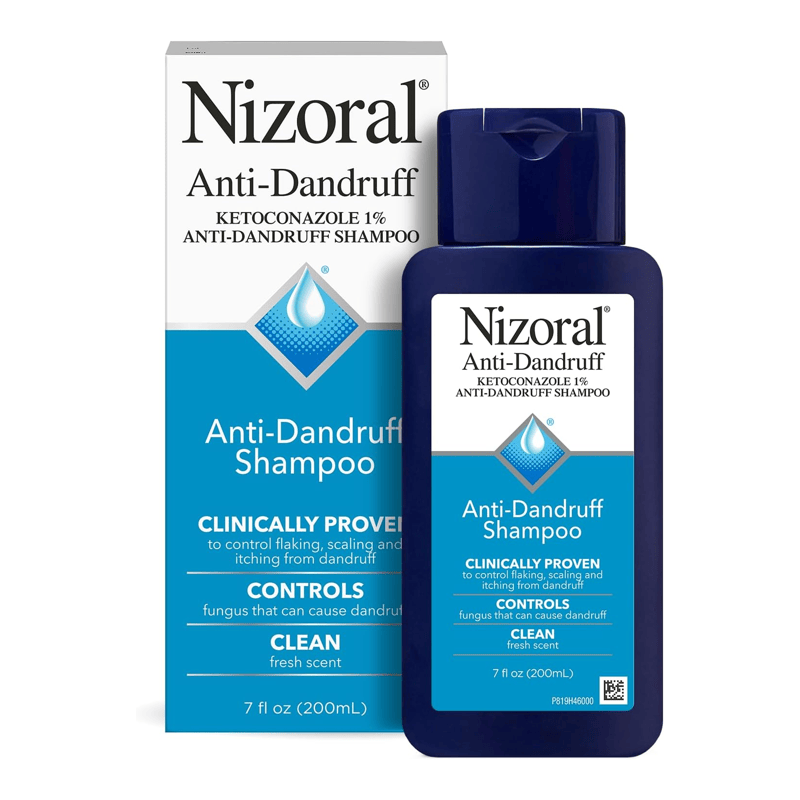
Nizoral Anti-Dandruff Shampoo runs about $17 for 7 ounces, though the price moves around. It’s 1% ketoconazole in a sulfate shampoo with a fresh scent, so it does have fragrance, and it deserves the full 2 to 4 weeks before you decide. It’s fine on colored and chemically treated hair. Dermatologists often suggest keeping a second dandruff shampoo to swap in if one stops working, and Head & Shoulders Clinical Strength Advanced Oil Control fills that spot for about $12. Its active is 1% selenium sulfide for dandruff and seborrheic dermatitis, it has fragrance, and if your hair is bleached, tinted, gray or permed, rinse for a full 5 minutes.
For the days in between, Vanicream Shampoo is about $11, a gentle sulfate-free wash for sensitive skin with no fragrance, plant extracts or essential oils, and it rinses away flakes and product buildup. Vanicream Conditioner, also about $11, skips protein, gluten, plant extracts and essential oils and rinses out clean. Keep it on your lengths rather than your scalp, where a medicated shampoo tends to leave things dry.
The label also tells you when to stop. If a rash shows up, or your scalp gets worse or hasn’t improved in 2 to 4 weeks, stop and check with a doctor, and don’t use it on broken or inflamed skin. The 2% label notes reports of changes in hair texture and color, and of perms losing their curl.
Pairing it with minoxidil
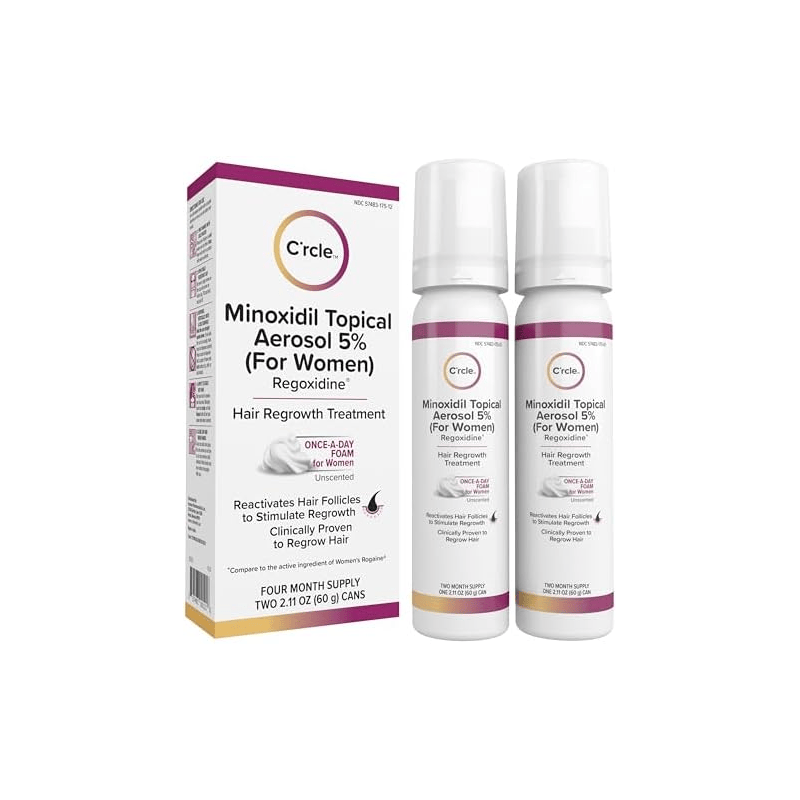
C’rcle Regoxidine Women’s 5% Minoxidil Foam is about $25 for two cans, roughly a four-month supply, and it’s the only pick here made to regrow hair, on the top of the scalp in women with hereditary thinning. Results can take 3 to 6 months of daily use, and it won’t work for every woman. Its label says not to use it if you’re putting other medicines on your scalp, or if your scalp is red, inflamed, irritated or painful, and a medicated shampoo counts as a scalp medicine. That doesn’t rule out using both. It just means the call belongs to a dermatologist who’s looked at your scalp rather than a comment thread. Our honest guide to minoxidil for women covers the foam in more detail.
If your hair loss came on suddenly, shows up in patches, started after a baby or an illness, or you simply aren’t sure why it’s happening, get a diagnosis first. Our piece on hair shedding vs. hair loss explains why the cause matters so much.
Is it worth a spot in your shower?
Flaky, itchy or greasy-red scalp, plus shedding? Treat the scalp. Nizoral twice a week for the label’s 8 weeks is a fair and inexpensive test, and a calmer scalp feels better either way.
A part that’s slowly widening on a scalp that feels fine is a different story. That pattern points to hereditary thinning, where minoxidil has far more proof behind it than ketoconazole does.
Hair that came out suddenly, in patches, or a few months after an illness or a baby calls for a dermatologist before you buy anything, because shampoo won’t touch any of those causes.
Curly, coily or color-treated hair? Keep the medicated lather on your scalp and condition your lengths afterward. You’ll find more ideas in our hair archive.
Ketoconazole and hair, the short version
Does ketoconazole shampoo regrow hair? It may help a little, but the proof is thin. Most of it comes from small studies, and it works best as an add-on rather than a treatment on its own.
How long does ketoconazole shampoo take to work for hair loss? Give it at least three months. Hair grows slowly, so changes in shedding or thickness take a while to show.
Can ketoconazole shampoo make hair fall out? Rarely. Dryness and a change in how your hair feels are more common, so follow it with conditioner and stop if shedding gets worse.
Should you see a dermatologist for thinning hair? Usually, yes, because the right treatment depends on the cause. Our guide to when a dermatologist is worth it for hair loss walks you through how to decide.


