
A CO2 laser is one of the strongest tools a doctor has for wrinkles, acne scars and sun damage, and the results can be gorgeous. The price you pay is a rough recovery, and how rough depends on which version you get. Fully ablative CO2 treats the whole surface, so it brings the biggest change along with the longest healing and the most risk, including skin lightening that can show up months later. Fractional CO2 treats tiny dots and leaves skin in between, so you heal in roughly a week to 10 days. Either one can leave dark patches on deeper skin tones, and the average surgeon’s fee is $1,829, according to the American Society of Plastic Surgeons (ASPS).
How a CO2 laser rebuilds your skin
Your skin is mostly water, and water soaks up this laser’s energy, so the surface heats up fast enough to vaporize. The heat that reaches a little deeper tightens your collagen and starts a healing process that keeps making new collagen for months.
Put simply, the laser injures your skin on purpose so it can rebuild itself. A deeper injury gets you a bigger change, and a harder recovery comes with it.
Plastic surgeons and dermatologists reach for it to treat:
- Fine lines and wrinkles around your eyes, mouth and forehead
- Acne scars and chickenpox scars
- Sun damage and age spots
- Rough, uneven texture, plus some growths like warts
The American Academy of Dermatology (AAD) calls laser resurfacing the most effective way to tighten loose skin without surgery. It still can’t lift real sagging the way a facelift can, so keep your expectations there.
Full-face CO2 or fractional CO2
The original CO2 laser is fully ablative, which means it treats your skin edge to edge. Many doctors still see it as the best for results, especially on deep wrinkles, and a review in Seminars in Plastic Surgery says no other device matches it. You usually need just one session. The healing is the hard part, with about two weeks of raw skin and redness that can hang on for months. It also carries a risk of scarring and, for some people, permanent skin lightening that doesn’t appear until months after treatment.
Fractional CO2 was made to get you close to that result with fewer problems. It treats tiny columns of skin and leaves healthy skin standing between them, and that untouched skin covers the wound quickly. One review puts the new surface at about three to six days, while the crusting and swelling usually wrap up in 7 to 10 days. Redness tends to last several weeks instead of months. Results are still strong, just a little less dramatic on deep lines, and one session is often enough, though some people need more.
Another review found that fractional lasers carry a much lower risk of lasting lightening, scarring and visible lines along the neck, which is why they’ve mostly replaced the full-face approach. Dark patches can still happen with either version. If you want something gentler, our guide to chemical peel depths walks through a similar ladder from light to strong.
If you’re also weighing Fraxel, our guide to Fraxel lasers explains how that brand’s fractional options compare.
Who CO2 suits, and who should skip it
CO2 resurfacing is a good match if you have fine to moderate wrinkles, sun damage or settled, sunken acne scars. You’ll also need to take a week or two off and then stay serious about sun protection for months afterward.
It’s not a good fit if you have:
- Active acne. ASPS and the American Society for Dermatologic Surgery (ASDS) both say to wait until it’s under control.
- Deeper skin tones. Both groups say very dark skin usually isn’t a good match, because dark patches after treatment show up most often in medium-brown and deep skin, and one review calls that risk with fractional CO2 “very high.” The usual alternative is a gentler laser that leaves the surface in place, used at careful settings.
- Very deep wrinkles or a lot of loose, sagging skin. Plastic surgeons say resurfacing may not suit you, since a laser can’t lift heavy skin. That’s really a conversation about surgery.
- A tan or sunburn. The AAD warns that tanned or burned skin can’t be treated, since the laser could leave it burned or discolored.
- Recent isotretinoin, a history of vitiligo or psoriasis, or a condition that slows healing. Any of these calls for extra caution or a different plan, so bring them up at your consultation.
If scars are your main goal, you’ll find much more in laser resurfacing for acne scars.
Getting ready, and the day itself
Prep often starts weeks ahead, and your doctor may put you on a skin care routine first. If you get cold sores, you’ll usually take an antiviral before and after, since the laser can trigger an outbreak around your mouth, and some doctors add an antibiotic as well. Doctors don’t all agree on retinoids. Some want you using one beforehand, while the AAD says to stop retinoids and glycolic acid two to four weeks ahead, so follow your own doctor’s plan. If you smoke, stop at least two weeks before.
On the day, small areas usually get numbing cream, while a full face might call for a sedative, a nerve block or general anesthesia. Treatment takes anywhere from 30 minutes to two hours, and it can hurt without numbing, which is why numbing is standard.
Your CO2 recovery timeline
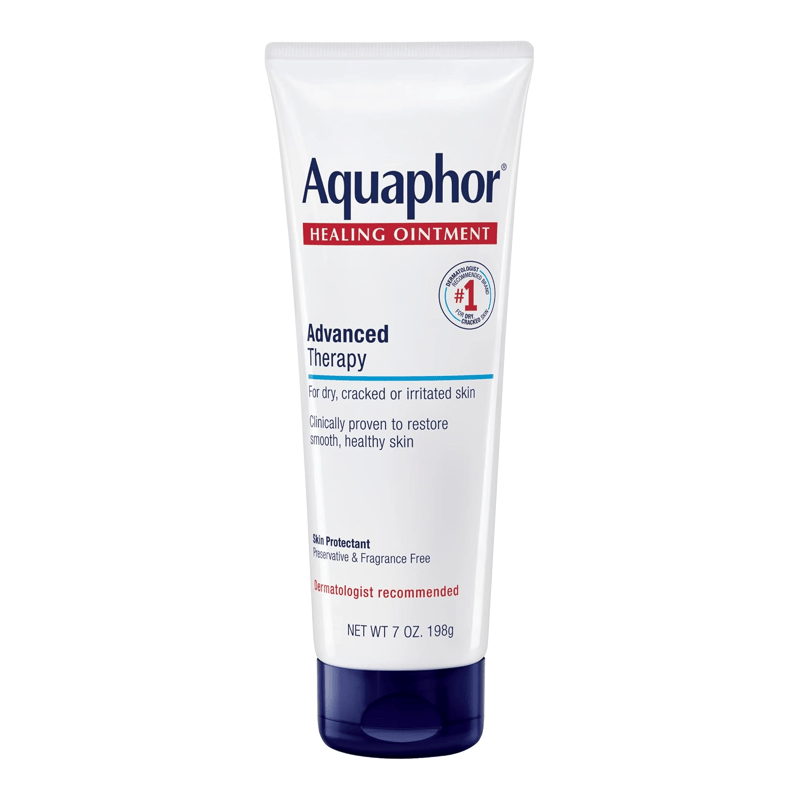
Days 1 to 3. Think bad sunburn. Your face will be red, swollen, raw and oozing, sometimes with a yellow crust. Sleep with your head propped on an extra pillow and use an ice pack for the first day or two. You’ll clean your skin several times a day, often with saline or a watered-down vinegar soak, then keep it covered in a thick layer of ointment so it never dries out. One fractional CO2 review names plain petrolatum or Aquaphor Healing Ointment as the way to keep healing skin moist, and it’s 41% petrolatum with no fragrance, though if your office hands you its own aftercare kit, go with that. Please don’t pick at the crust, because that’s how scars happen.
Days 4 to 10. New skin forms underneath while the crust and dry skin start to peel away. With fractional CO2, this is when you start looking like yourself again. Once your doctor clears you to go back to a regular wash, a soap-free, fragrance-free cleanser like Vanicream Gentle Facial Cleanser takes over from the saline or vinegar soaks. The full version takes longer, up to about two weeks.
Weeks 2 to 12. Your new skin will be pink, and that fades over two to three months, though the last bit can take up to a year. Blondes and redheads tend to stay pink longer. Once you’ve fully healed, a green-tinted, oil-free makeup can calm the color down.
The first year. Your skin burns more easily for up to a year, so daily sunscreen isn’t optional. A gentle mineral formula like Blue Lizard Sensitive Mineral Sunscreen SPF 50, with zinc oxide and titanium dioxide, is a good fit once you’ve healed over, since no sunscreen is meant for broken skin. Hold off on acids, retinoids and scrubs until your doctor gives the okay. The fun part is that your results keep getting better as your collagen rebuilds.
What can go wrong after CO2
- Darker patches (hyperpigmentation). This is the most common color change, especially on deeper skin tones. It’s often temporary and treatable, though it doesn’t always clear quickly.
- Lighter patches (hypopigmentation). This one is less common, but it can be permanent and can appear months later, which makes it the big risk with the full version.
- Infection. Cold sores are the most common kind, while bacterial and yeast infections are rarer. Healing that drags on longer than you were told can be a sign, so call.
- Scarring. It’s rare but possible. Your neck scars more easily than your face, so it gets treated more gently.
- Acne flares, milia (tiny white bumps) and redness or swelling that lingers.
Call your doctor if you’re healing more slowly than expected, if pain or swelling gets worse instead of better, or if new sores pop up around your mouth.
What CO2 resurfacing costs
The latest ASPS figures put the average fee for laser skin resurfacing at $1,829, and that number covers only the procedure itself. Anesthesia, the facility and your prescriptions cost extra, and prices swing depending on your city and who’s running the laser. Insurance treats it as cosmetic, so you’ll usually be paying out of pocket.
Finding your CO2 starting point
If you have fine lines and sun damage and can take a week off, ask about fractional CO2. It’s the version most offices use, and the recovery is very doable.
If you have deep wrinkles around your mouth, ask whether the full version on just that area makes sense, and what the lightening risk looks like for your skin.
If you have medium-brown or deep skin, CO2 usually isn’t the place to start. Ask about gentler lasers or microneedling from someone with lots of experience treating skin like yours, and our microneedling vs Morpheus8 post is a great place to begin.
If cold sores are a thing for you, bring them up at your consultation, even if your last one was years ago.
If you can’t stay out of the sun for the next few months, hold off. A summer packed with beach trips is a bad time to have brand-new skin, and you’ll find plenty of other treatment ideas in our skin archive while you wait.
CO2 laser, the essentials
Does CO2 laser hurt? It’s uncomfortable, so you’ll get numbing cream, numbing shots or sedation, depending on how deep it goes. Afterward it feels like a bad sunburn for a few days.
How many CO2 laser treatments do you need? Often just one for a full resurfacing. Lighter fractional treatments may take more than one.
How long do CO2 laser results last? Years. Your face keeps aging, so it won’t freeze time, but the improvement holds up well.
Who should do a CO2 laser treatment? A board-certified dermatologist or plastic surgeon with real CO2 experience. If someone else runs the laser, the doctor should be supervising closely.


